
Webinar: SAF Certificates (SAFc) Explained
A webinar hosted by Joulec on how SAF certificates work, the latest market developments, and where they fit in addressing air travel emissions for New Zealand and Australian organisations.
SAF certificates (SAFc) are becoming a recognised way for organisations to address their business travel and air freight emissions. There's a lot happening in this space:
The Science Based Targets initiative (SBTi) has approved the use of SAF certificates to address business travel and air freight emissions. Until now, cutting flying was the only recognised option.
In New Zealand, Air New Zealand's SAF certificates are now recognised under Toitū's Climate Impact Programme.
Members of the Sustainable Aviation Buyers Alliance (SABA), including Google, McKinsey, and Bain, have signed binding, multi-year agreements for SAF certificates (over 200,000 tCO2e), to help finance a new eSAF facility.
For many organisations, this raises practical questions. What exactly are you buying with a SAF certificate, and where does it fit alongside your other options?
This webinar is a straightforward introduction to SAF certificates: what they are, why they exist, and what's happening in the market. We cover:
How SAF certificates work, including book and claim, and how they compare with renewable electricity certificates.
Insetting vs offsetting, and how SAF certificates differ from carbon credits.
Where SAF certificates fit in your emissions strategy, including the emissions hierarchy, the latest SBTi changes, and Toitū recognition.
The market today: what SAF certificates cost per tCO2e, action in New Zealand and Australia, and how leading global buyers are catalysing the market.
What to get right before you buy.
Who this is for
Sustainability, procurement, and travel professionals at New Zealand and Australian organisations considering SAF certificates for business travel or air freight. No knowledge or experience of SAF required.
Webinar: The State of Sustainable Aviation Fuel (SAF)
Globally, sustainable aviation fuel (SAF) is picking up pace, and is increasingly recognised as strengthening energy security, creating jobs in regional economies, and decarbonising aviation.
There’s a lot happening globally and this impacts New Zealand:
The Iran conflict has sent jet prices soaring and highlighted the vulnerability of New Zealand’s fuel supply chains. In New Zealand, we import 100% of our jet fuel.
Australia has committed to investing $1.1 billion AUD in building a cleaner fuels industry (including SAF) and is currently consulting on a 1 – 4% mandate by 2030.
The Science Based Targets Initiative (SBTi) has approved the use of SAF certificates to address business travel and air freight emissions. Until now, cutting flying was the only recognised option.
These reflect a significant shift. SAF is moving from a niche decarbonisation lever to a key component of industrial strategies and mainstream climate policies.
New Zealand is geographically isolated from the rest of the world. We rely heavily on aviation for business, tourism, and connection both internally and internationally.
So where does SAF fit in New Zealand’s future? Are we keeping up, and what might that mean?
This webinar is a straightforward session on where SAF is at: how much is being produced, how fast it’s growing, the challenges, the costs, and what would need to change for New Zealand to make material progress in the space.
The session builds from the basics to the “so-what” for your organisation. We will cover:
A “state-of-play” on SAF: the “why,” the role of next-generation aircraft, and the status of global SAF use and production.
New Zealand’s domestic production potential, including projects in the pipeline, the role of new feedstocks and technologies in growing supply, and the sustainability impacts.
The impact of policy on SAF, including examples from Australia, Singapore, Japan and the United States.
The role of corporates: why airlines cannot fund SAF on their own, what that means for organisations’ decarbonisation goals, and how global corporate buyers like Microsoft and Google are enabling growth in SAF supply.
Ultimately, we will explore New Zealand’s SAF and aviation decarbonisation trajectory, and what it would take to shift the dial.
Who this is for? New Zealand-based sustainability and energy professionals, procurement leads, travel managers, exporters, and anyone with an interest in sustainable aviation fuel and clean technologies. No knowledge or experience of SAF required.
Who is speaking? Isobel Campbell is the Founder and Principal Advisor at Joulec Energy and Carbon Consulting Phil Moore is the Global Head of SAF at EcoCeres
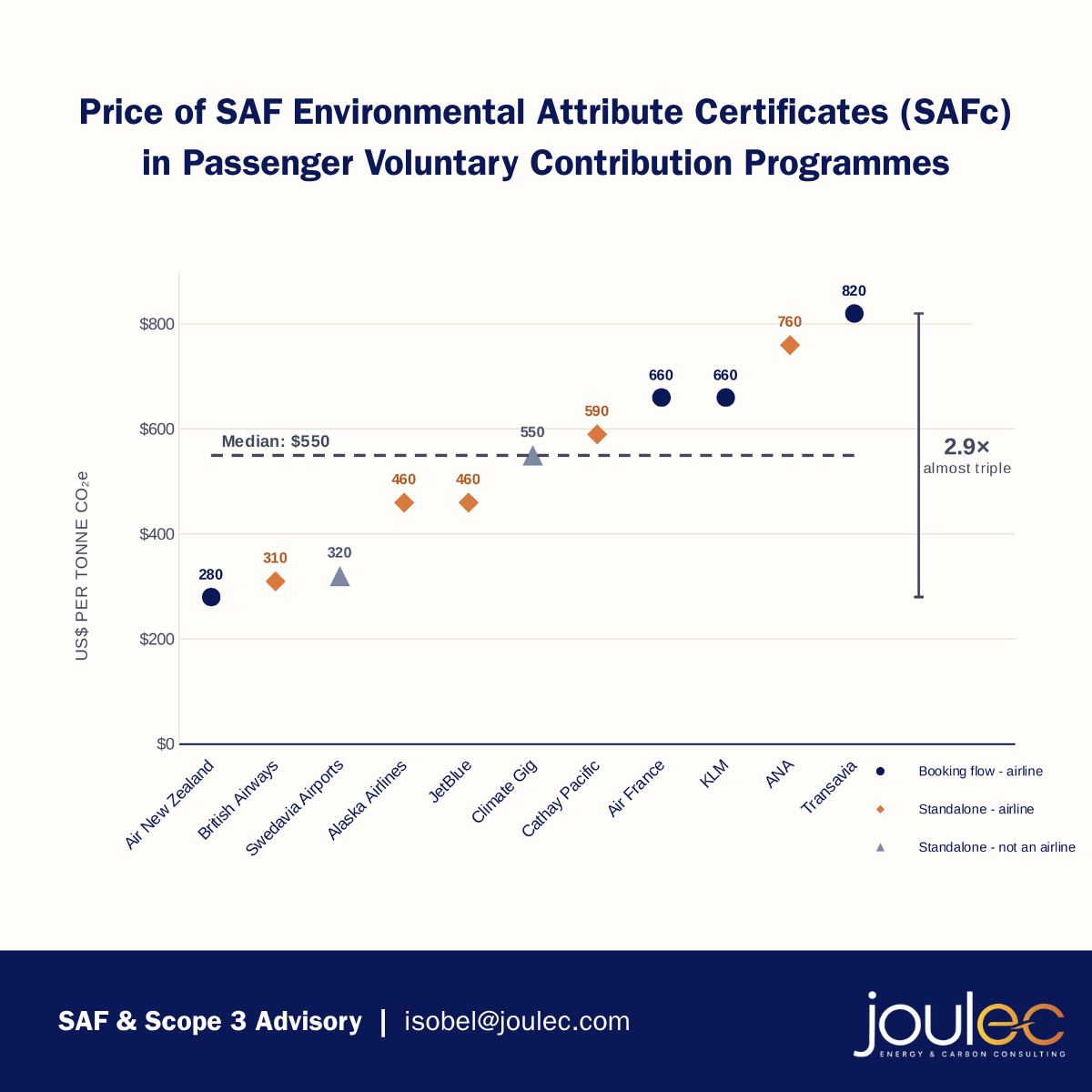
Analysis: Price of SAF Environmental Attribute Certificates (EACs) in Passenger Voluntary Contribution Programmes
For your average traveller or corporate, it isn’t easy to find the cost of sustainable aviation fuel (SAF) to address air travel emissions. Pricing is behind paywalls, request-access logins, and corporate programmes.
But there’s one source that is a “free-for-all”: passenger contribution programmes (in online bookings or standalone sites).
This analysis looks at the cost of SAFc across various airline programmes for passengers.