
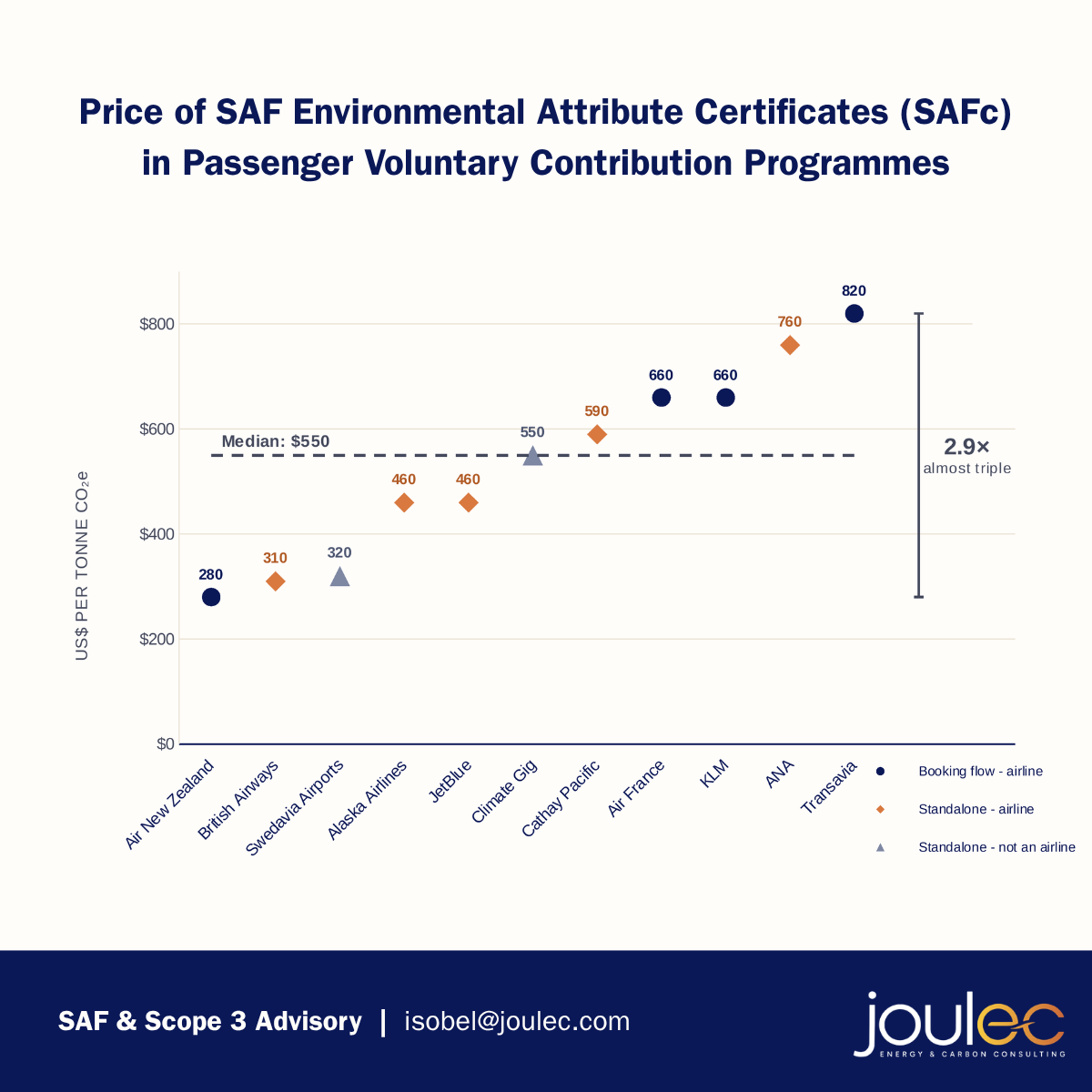
For your average traveller or corporate, it isn’t easy to find the cost of sustainable aviation fuel (SAF) to address air travel emissions. Pricing is behind paywalls, request-access logins, and corporate programmes.
But there’s one source that is a “free-for-all”: passenger contribution programmes (in online bookings or standalone sites).
The data isn’t always in a “ready-to-use” format, but with a little reverse engineering, I've determined the $/tCO2e. This is effectively the price of a Scope 3 Environmental Attribute Certificate (EAC) aka SAFc.
And I found a huge spread in pricing across programmes, from $280 to $820 USD/tCO2e.
The highest price is nearly triple the lowest. Why is the range so big?
The place to start: the underlying cost of SAF.
It can vary considerably by region. In places like California, incentives can halve the SAF premium, so you might see ~$200–300/tCO2e, while in Asia or Europe, the same SAF could be $400–600/tCO2e.
My analysis shows almost a continuous spread in SAFc prices, but I’ve grouped them into three to compare the SAFc price to the actual cost of SAF (see comments for method notes).
• Low - $280–320: in line with incentivised SAF in NAM.
• Mid - $460–600: in line with unincentivised SAF in Asia & Europe.
• High - $600+: (likely) more than the SAF cost. Either the airline or the SAFc customer is getting a bad deal.
So a x2 pricing difference in SAFc could reflect differences in underlying SAF costs. A x3 multiplier probably doesn’t.
But looking at these figures, you’ll see JetBlue and Alaska in the mid-band. Given they’re NAM-based, you would expect them to secure incentivised NAM SAF. So, incentives and geography alone don’t necessarily tell the full story.
What other factors might influence SAFc pricing?
• The cost of SAF to the airline: impacted by contract length, volume, feedstock, sustainability credentials, timing, or negotiation success.
• SAFc programme costs: transaction fees, software, staff and other overheads.
• Incentives: federal, state or airport incentives or tax credits.
• Airline approach: are they co-funding the premium, break even, or making a margin?
We can’t determine the unique driver for each price, but on a pure dollar basis, some suppliers are considerably better value than others.
What this means:
If you’re a corporate buyer, treat these prices as the upper limit. Negotiate from here, especially if you’re buying large volumes. And ask for more information on SAF location, incentives, feedstocks, and registries.
If you’re a traveller, perhaps buy the lowest cost SAFc or from an airline you want to support on SAF. There’s not enough public information to differentiate on anything else.
Analysis: Price of SAF Environmental Attribute Certificates (EACs) in Passenger Voluntary Contribution Programmes
Previous
Previous